May 10, 2026
- Issue 10
- 4 min read
- 16 stories / 5 sections
The central story is trust: how AI systems are tested, measured, and put to work. Issue 10 connects public-sector AI, enterprise AI services, frontier models, and model evaluation, showing how AI is moving into public and private institutions at the same time.
Contents (5 sections)
Policy & Regulation
Privacy, ethics, governance, regulation
- 01
Greece proposes constitutional safeguards on artificial intelligence (opens in new tab)
Greece is updating its constitution to ensure that artificial intelligence serves human society. Prime Minister Kyriakos Mitsotakis described these changes as essential for protecting future generations.
- 02
Google, Microsoft and xAI agree to US government AI testing programme (opens in new tab)
Google, Microsoft, and xAI will allow the US government to test their artificial intelligence models before public release. The evaluations, conducted by the Center for AI Standards and Innovation, will focus on risks related to cybersecurity, biosecurity, and chemical weapons.

Government & Public Sector
Federal use, public-sector AI, sovereign compute
- 01
Trump admin floats policy language limiting contractor say on agency uses of technology (opens in new tab)
The Trump administration is considering policy changes that would limit how private technology contractors can influence the government’s use of artificial intelligence. Draft documents suggest the government wants clear control over technology applications, emphasizing that elected officials should determine lawful uses rather than companies.

- 02
Meta-Backed Scale AI Wins $500 Million Defense Department Deal (opens in new tab)
The Pentagon awarded a $500 million contract to Scale AI, which is backed by Meta Platforms Inc., to analyze data and support decision-making. This new deal marks a five-fold increase from a previous $100 million contract and highlights the military's growing commitment to artificial intelligence technology.

Industry & Models
Investment, M&A, models, agents, coding, ASI/AGI
- 01
Anthropic and OpenAI are both launching joint ventures for enterprise AI services (opens in new tab)
Anthropic announced a joint venture for enterprise AI services with partners including Blackstone and Goldman Sachs, valued at $1.5 billion. Hours earlier, OpenAI revealed a similar venture called The Development Company, aiming to raise $4 billion, indicating strong competition between the two firms in the enterprise AI space.

- 02
OpenAI rolls out new model for cybersecurity teams a month after Anthropic's Mythos debut (opens in new tab)
OpenAI launched GPT-5.5-Cyber, a new model designed for cybersecurity teams, shortly after Anthropic's Mythos preview. This upgrade focuses on tasks like vulnerability identification and malware analysis and is available to a wider range of vetted users than its competitor.

- 03
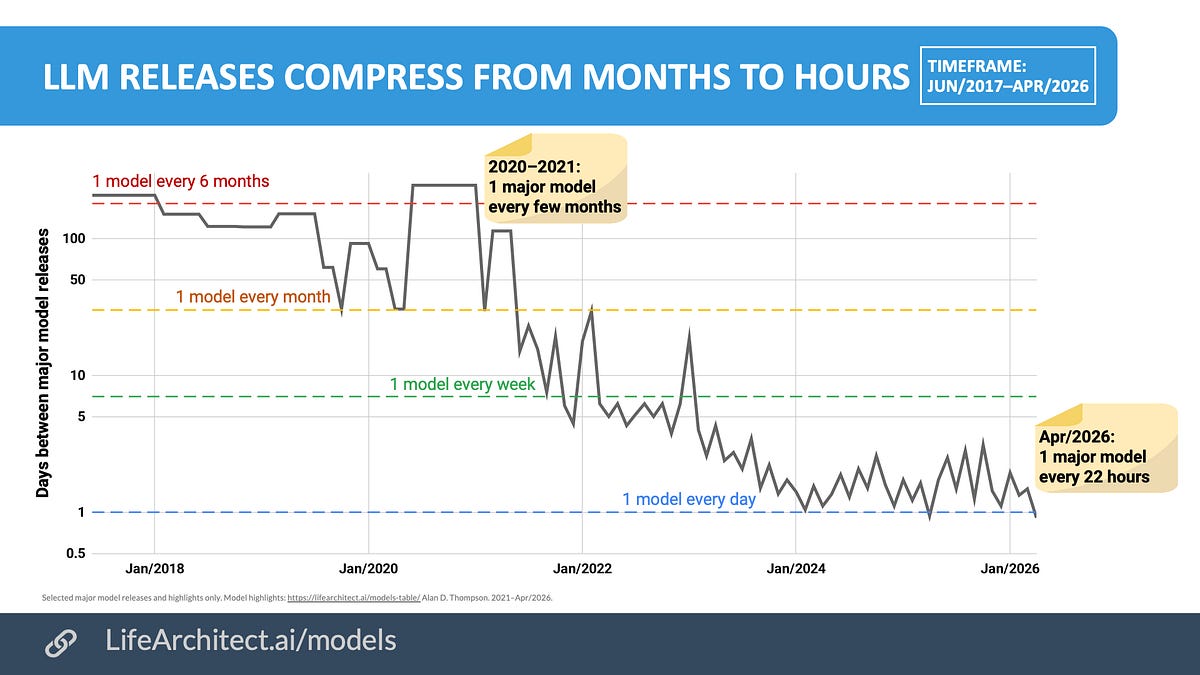
The Memo - 10/May/2026 (opens in new tab)
Models Table Pro, Anthropic 80-fold growth, OpenAI phone rumors, and much more!
- 04
Import AI 455: Automating AI Research (opens in new tab)
Welcome to Import AI, a newsletter about AI research. Import AI runs on arXiv and feedback from readers. If you’d like to support this, please subscribe. Subscribe now AI systems are about to start building themselves. What does that mean? I’m writing this post because when I look at all the publicly available information I […]

Sectors & Applications
Agriculture, environment, jobs, applied AI
Research
Trending AI research papers from arXiv and Hugging Face
- 01
AI lets chemists design molecules by simply describing them (opens in new tab)
A new AI system called Synthegy allows chemists to design complex molecules by using simple language to guide synthesis and reaction planning. This tool improves the retrosynthesis process by combining algorithms with large language models, enabling faster and more intuitive decision-making.

- 02
Review of the "Risks from automated R&D" section in the Anthropic Risk Report (February 2026) (opens in new tab)
We reviewed the “Risks from automated R&D” section of Anthropic’s February 2026 Risk Report , producing two corresponding review documents: our original review and our updated review . We recommend that readers refer to our original review, which represents our review of the report as originally received. We expect the public version of the report to be updated to resemble the changes anticipated in our updated review in content, though not necessarily in exact wording. We expect our updated review to cover those changes, but if the updated public version includes any changes that materially affect our opinion...

- 03
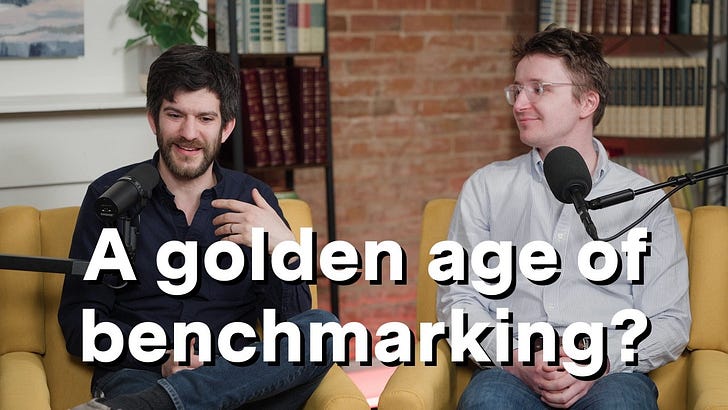
Are AI benchmarks doomed? (opens in new tab)
In this episode, Greg Burnham and Tom Adamczewski join Anson Ho to push back on benchmark pessimism and dig into what the next generation of AI benchmarks could look like.
- 04
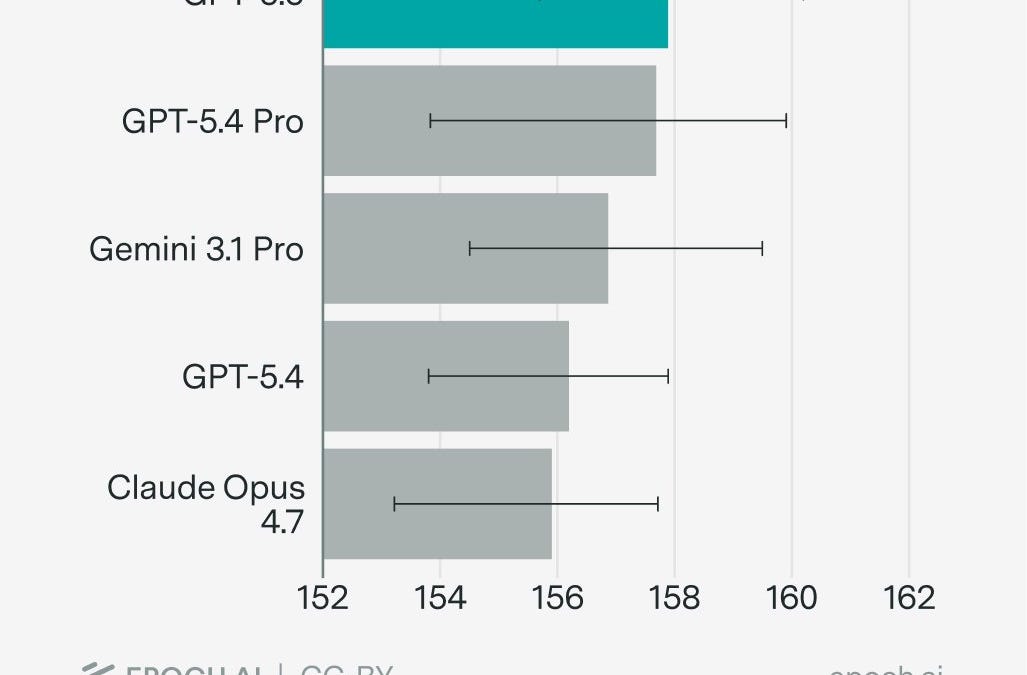
GPT-5.5 Pro achieves a new high score on the ECI (opens in new tab)
GPT-5.5 Pro achieves a new high score of 159 on the Epoch Capabilities Index — our statistical tool that combines multiple benchmarks into a unified scale.
- 05
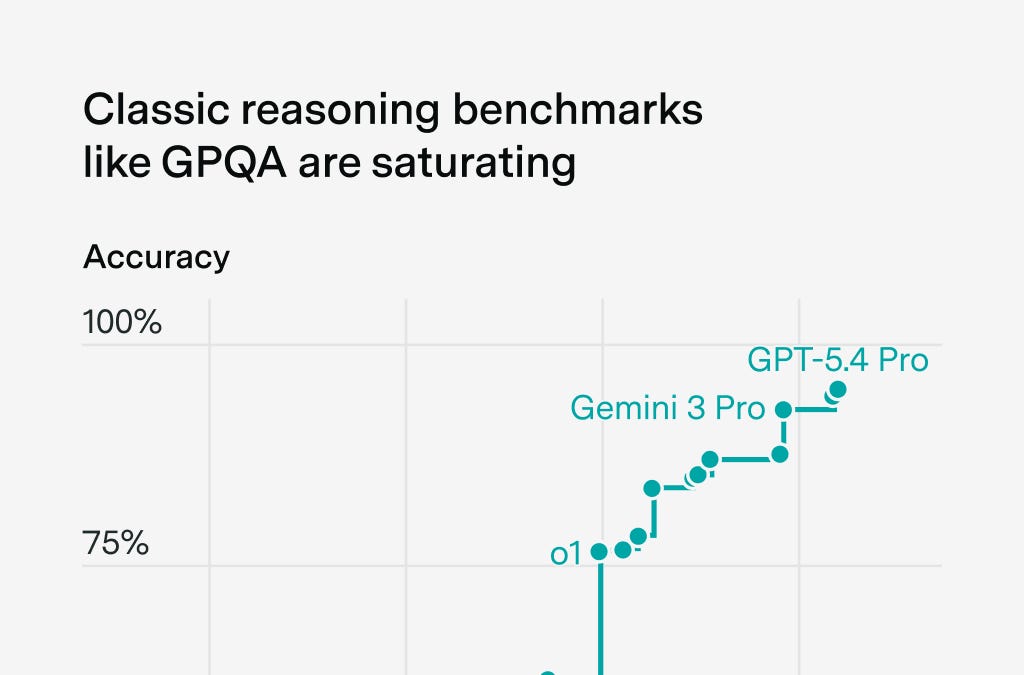
RIP Classic Reasoning Benchmarks. What’s Next? (opens in new tab)
Give up at least one of: text only, short time horizon, easy to grade, and expert human superiority.
- 06
Task Substitution and Uplift (opens in new tab)
Summary: We describe three different definitions of the productivity impact of AI (AKA uplift), and show there’s reason to expect: \[\text{uplift on old tasks} \leq \text{uplift in value} \leq \text{uplift on new tasks}\] Three Measures of Uplift One complication in measuring AI’s effect on productivity is that it has different effects on different tasks, and this causes people to change how they allocate their time between tasks. This makes it more difficult to talk about the effect of AI on overall productivity. We use “old tasks” to mean the set of tasks you’d do in a typical day before AI is available – yo...
- 07
The Epoch Brief - May 8, 2026 (opens in new tab)
AI chip supply chain bottlenecks, smuggling to China, benchmark saturation, revenue efficiency at AI companies, and more

- 08
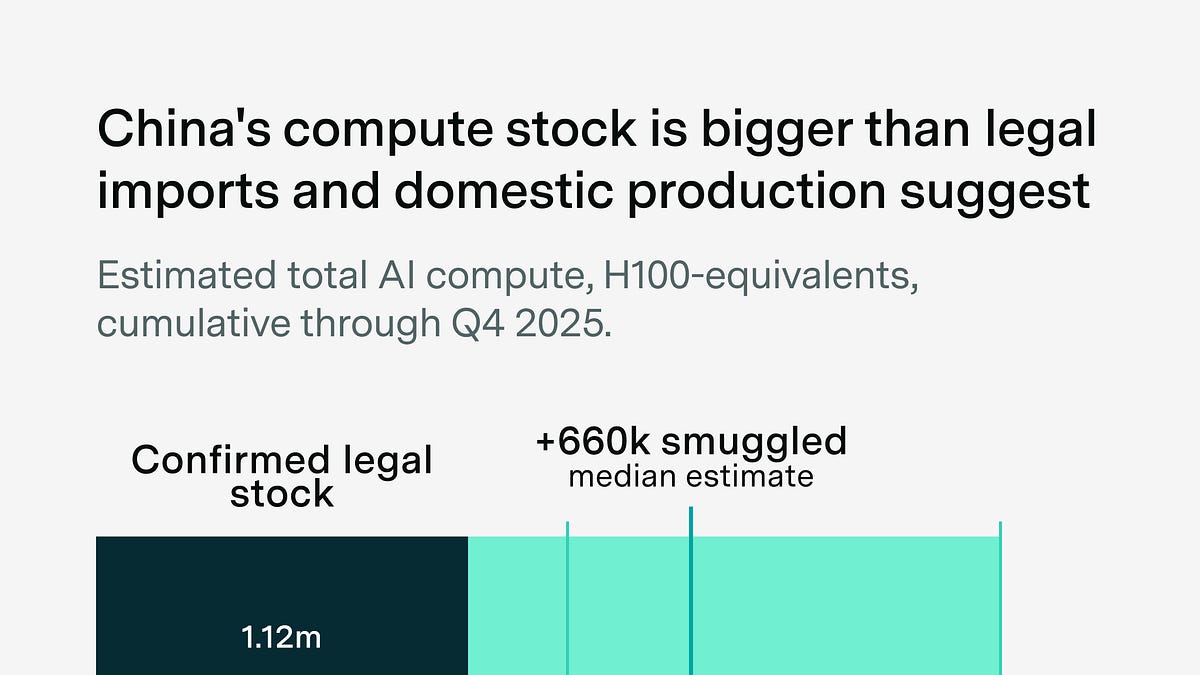
Diversion and resale: estimating compute smuggling to China (opens in new tab)
We estimate that between 290,000 and 1.6 million H100-equivalents (H100e) were smuggled to China through 2025. Our median estimate of 660,000 H100e would be roughly a third of China's total compute.